Agentic AI as an Internal Product: Building PM Copilots for Your Own Organization
Treat internal AI like a product: discovery, a tight pilot, honest feedback and real adoption metrics.
For the last few years, most of the conversation about agentic AI inside product organizations has been pointed outward. How do we put an agent in front of our customers? How do we make our product feel smarter? How do we compete on AI features?
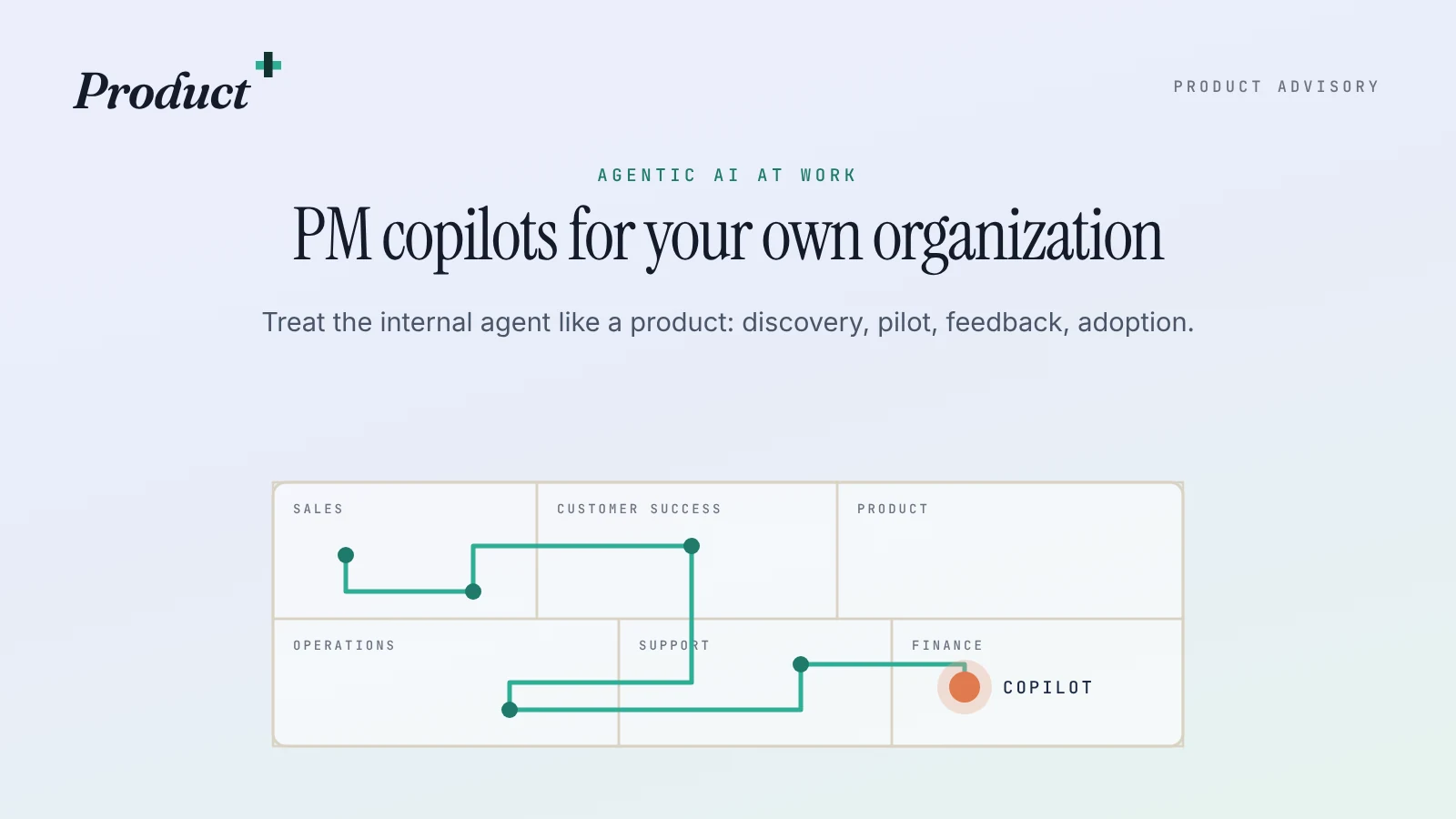
That's a real conversation, but it's not the only one worth having. Some of the highest-leverage AI work I've seen doesn't touch a customer at all. It shows up inside the company, quietly changing how sales reps prep for calls, how customer success handles renewals, or how ops triages a backlog of tickets. I've started calling these PM Copilots, and I think product leaders are underrating them.
Here's the thing, though. Building a copilot for your own sales or CS team is still product work. It just gets treated like IT work far too often, which is exactly why so many of these efforts stall out after a promising demo. If you want one of these tools to actually get used six months from now, you have to run it through the same discipline you'd apply to anything you'd ship externally: real discovery, a tight pilot, honest feedback loops, and metrics that tell you the truth.
Why internal AI tools deserve product rigor, not IT rigor
When something is being built for internal use, there's a natural pull toward treating it as a technical project instead of a product. Someone in ops says "we need a bot that can summarize tickets," an engineer builds it in a sprint, it gets dropped into a Slack channel, and everyone moves on. Three months later, nobody's using it, and nobody can quite explain why.
The reason is almost always the same one that kills external products: nobody validated the problem, involved the users early, or built in a way to learn and adjust. Internal stakeholders are still users. They still have workflows, trust issues, and opinions about tools getting shoved into their day. Treating them as an afterthought instead of a customer is the single biggest reason these projects fail quietly.
So the fix is simple to state, even if it takes real discipline to execute: run your internal AI agent through the same lifecycle you'd use for any product bet.
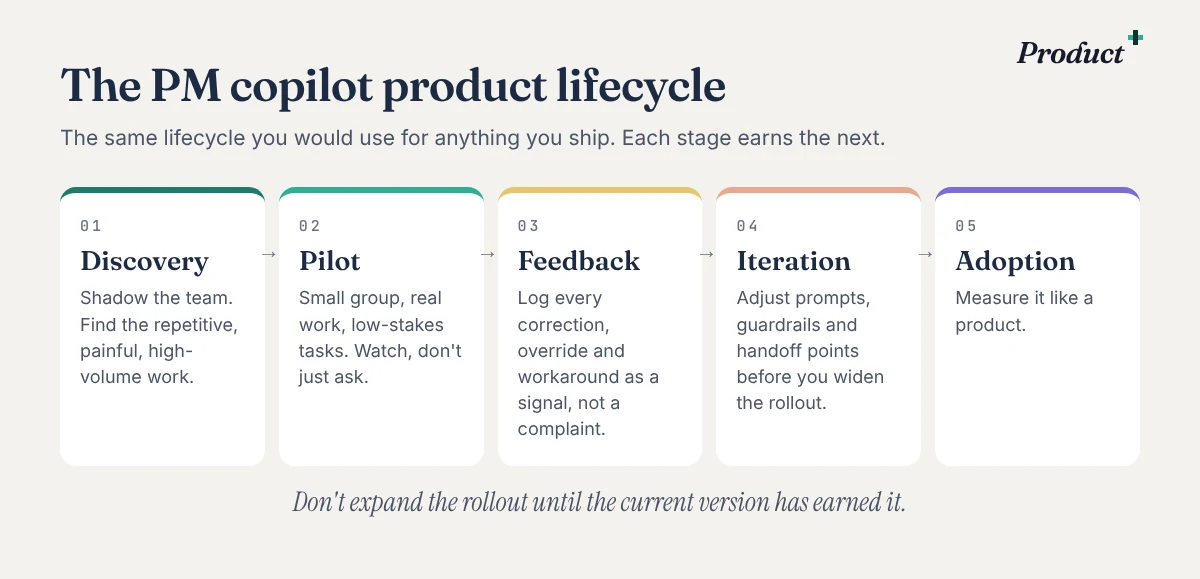
Discovery: find the work worth automating, not the work that looks impressive
The instinct with agentic AI is to reach for the most ambitious use case. A copilot that handles an entire customer renewal end to end sounds impressive in a slide. It's also a terrible place to start.
Good discovery for an internal copilot looks a lot like good discovery for anything else. Spend real time with the team you're building for. Sit in on sales calls. Read a week's worth of support tickets. Shadow someone doing a task you assume is automatable and watch where they actually get stuck, because it's rarely where you'd guess.
You're looking for work that is repetitive, high volume, and low risk if the agent gets something wrong early on. Drafting a first pass at a follow-up email is a good candidate. Making a judgment call on whether to escalate a churn-risk account is not, at least not yet. The best early copilot use cases save someone real time on something tedious without putting anything irreversible in the agent's hands.
One more thing worth saying plainly: ask the team what they'd actually want help with, not what leadership assumes they need. The gap between those two things is where most failed pilots come from.
Pilot: small, real, and closely watched
Once you've picked a use case, resist the urge to roll it out broadly. A pilot with five to ten people doing real work is worth more than a company-wide launch with a flashy announcement.
Treat this phase the way you'd treat a beta. Pick people who represent a range of comfort with new tools, not just your most enthusiastic early adopters. Give them real tasks, not sandboxed test cases, because people behave differently when the stakes are real. And build in a way to watch what's actually happening, not just what people tell you afterward. Session logs, transcripts, and time on task will tell you more than a survey ever will.
This is also where you'll learn the difference between a demo and a product. A demo works when you control the inputs. A product has to survive a rep who pastes in a half-finished email thread, or a support agent who asks the copilot something it was never trained to answer. Pilots surface those edge cases while the blast radius is still small.
Feedback: listen for corrections, not compliments
Feedback on an internal AI tool rarely shows up as a formal ticket. It shows up as someone quietly editing every draft the copilot produces, or going back to doing the task manually because it's faster than fixing what the agent got wrong. If you're only listening for complaints in a feedback channel, you'll miss almost everything useful.
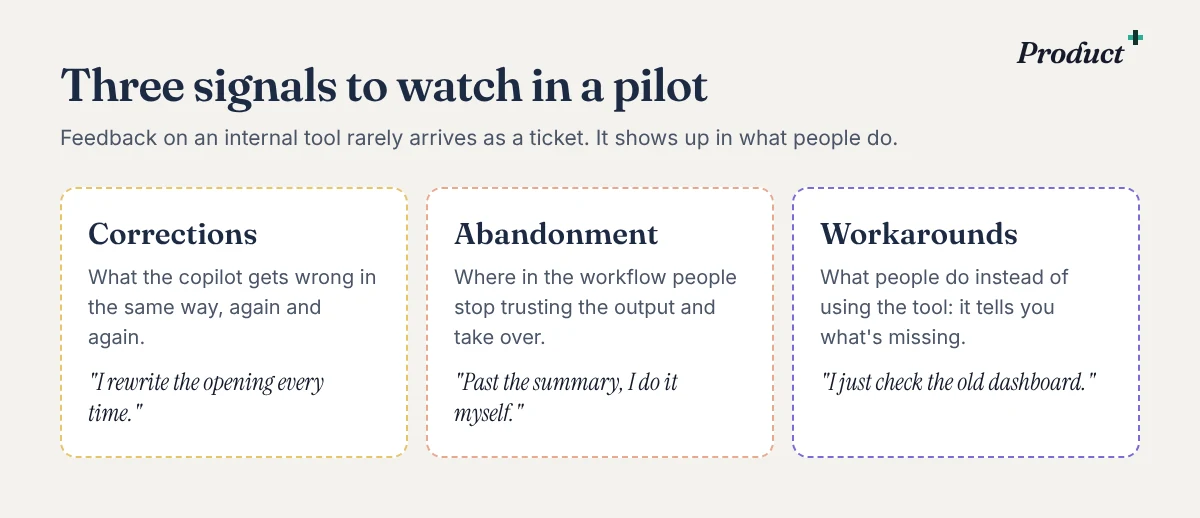
Build a habit of watching for three signals in particular:
- Correction patterns: what the copilot consistently gets wrong in the same way.
- Abandonment: where in a workflow people stop trusting the output and take over themselves.
- Workarounds: what people are doing instead of using the tool, because that tells you what the tool is missing.
It also helps to talk to the people who stopped using it, not just the ones still showing up. Churn on an internal tool is quiet. Nobody files a complaint when they just go back to the old way of doing things.
Iteration: earn the next stage of rollout
Every round of pilot feedback should change something concrete. That might mean adjusting the prompt or the guardrails, changing what the agent is allowed to do without a human checking its work, or narrowing the scope because you tried to solve too much at once.
A useful rule here: don't expand the rollout until the current version has earned it. If a copilot is getting corrected on the same kind of task every week, more users won't fix that; they'll just multiply the frustration. Iteration is where you build the trust that adoption actually depends on.
Adoption: measure it like the product it is
This is the stage most internal AI efforts skip entirely, and it's the one that determines whether the tool survives past its first quarter. If you can't point to numbers that show the copilot is actually helping, it will get quietly deprioritized the moment budget gets tight or a reorg happens.
The metrics that matter for a PM Copilot look a lot like the metrics you'd track for any product, just tuned for an internal audience.
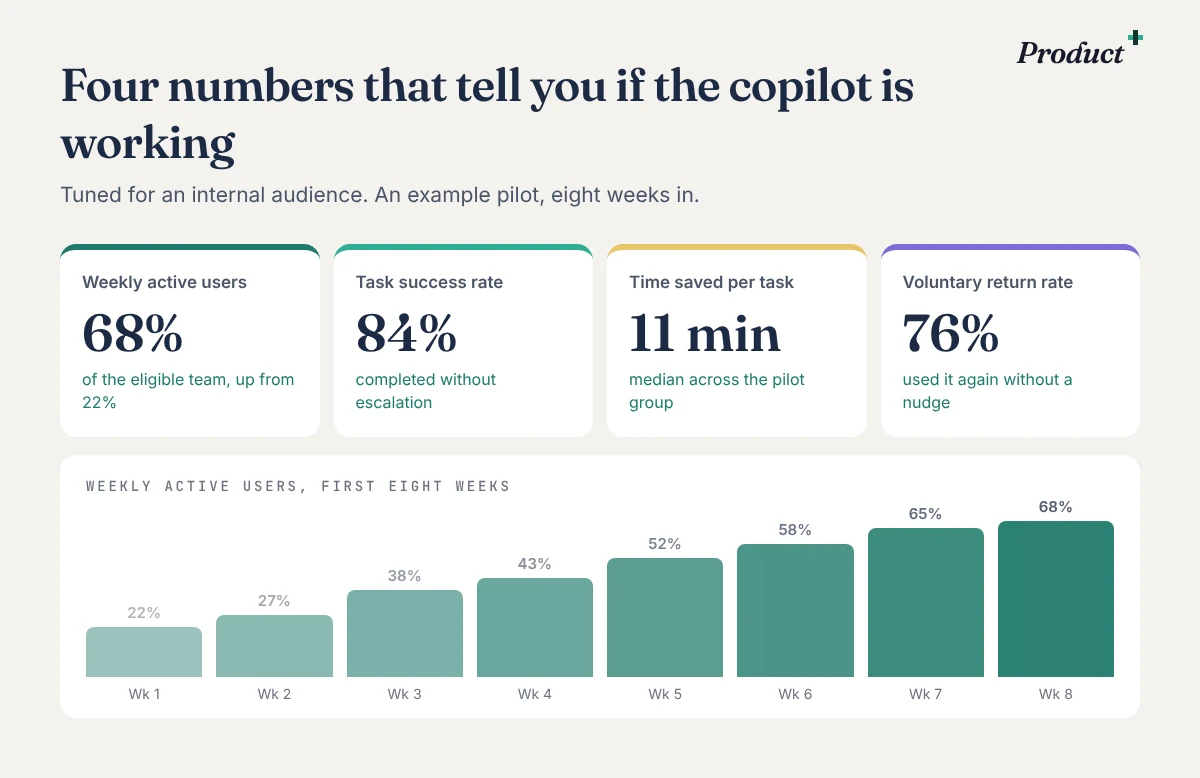
- Weekly active users among the eligible group tells you whether the tool has staying power beyond the initial curiosity.
- Task success rate, the share of tasks completed without a human having to step in and fix things, tells you whether the agent is actually reliable.
- Time saved per task is the number that will matter most to your VP or CFO, so get comfortable measuring it honestly rather than optimistically.
- Voluntary return rate, the share of people who come back without being reminded or told to, is maybe the most honest signal of all. People don't return to tools that waste their time, no matter how good the announcement email was.
The mindset shift
If there's one idea to take from this, it's that an internal AI agent is not a shortcut around product discipline; it's a test of it. The stakeholders are internal, and the "customers" sit down the hall or on the same Zoom calls you're already on, but the job is the same one you already know how to do. Understand the problem before you build. Pilot small and watch closely. Treat feedback as data, not noise. Iterate before you scale. And measure adoption honestly, even when the story it tells isn't the one you were hoping for.
PMs who get good at this are going to be unusually valuable over the next few years, not because they know how to prompt a model, but because they know how to turn a promising capability into something people actually trust and use. That skill was never really about AI. It's just product management, applied to a new kind of teammate.
Questions people ask
What is a PM copilot?
An AI agent built for your own organization rather than your customers: for example, helping sales reps prep for calls, customer success handle renewals, or operations triage tickets. It is an internal product, so it needs the same product discipline as anything you ship.
Why do internal AI tools fail?
Usually for the same reasons external products fail: nobody validated the problem, involved the users early, or built in a way to learn and adjust. Internal tools fail quietly: people simply go back to the old way of working.
What should an internal AI copilot do first?
Work that is repetitive, high volume and low risk if the agent makes a mistake early on, like drafting a first pass at a follow-up email. Leave judgment calls, like whether to escalate a churn risk, for later.
How do you measure whether an internal copilot is working?
Track weekly active users among the eligible group, task success rate (tasks completed without a human fixing them), time saved per task, and voluntary return rate: the share of people who come back without being reminded.
Putting this into practice
How Product Advisory helps teams with this: