The $100 Staircase
What Apple's pricing teaches product managers about the art of the upsell.
Apple never asks you to jump. It only asks you to take one more step.
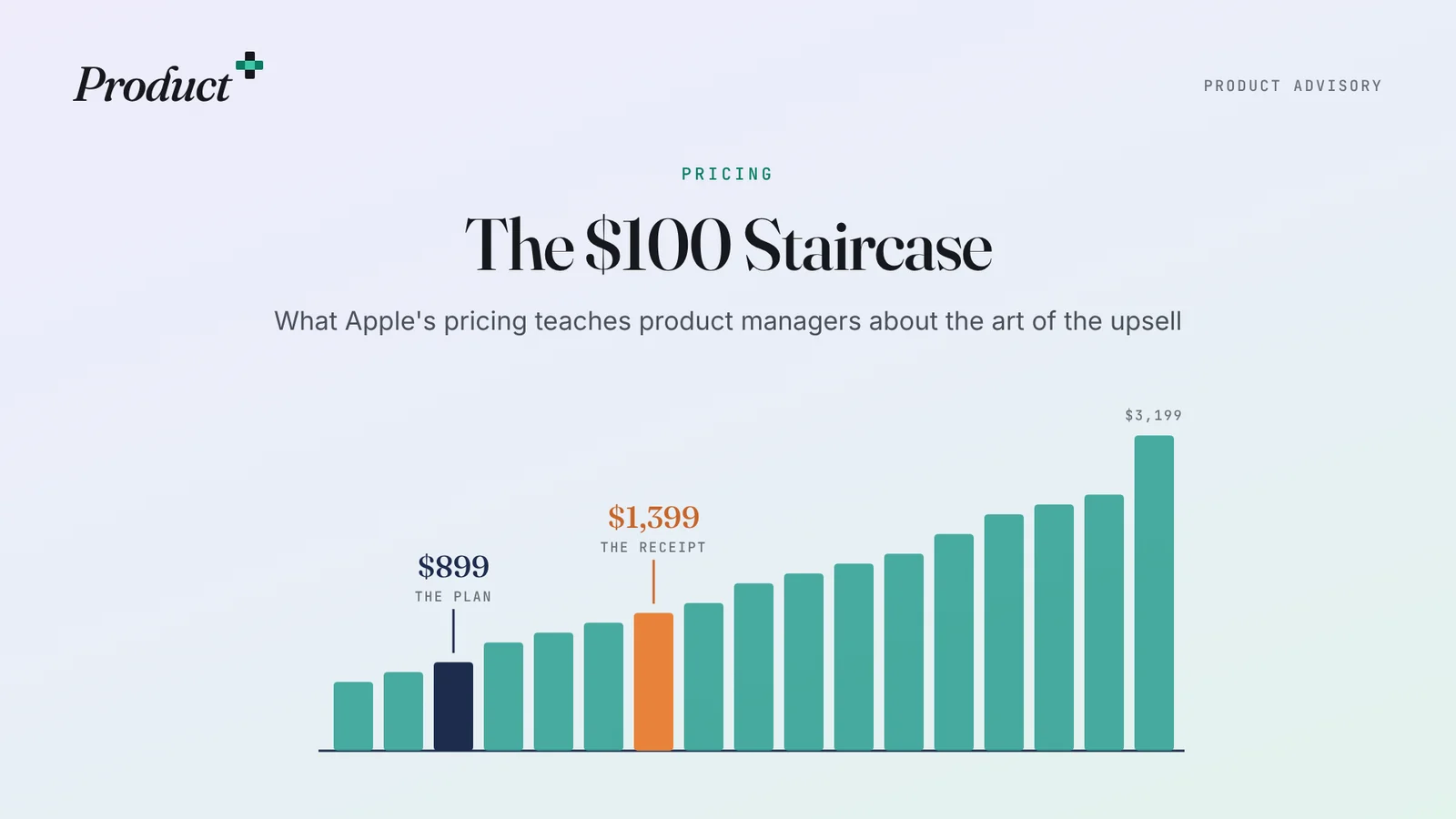
Jordan walked into the Apple Store on a Saturday morning with a clear plan and a number in mind. Her phone was four years old, the battery gave out by midafternoon, and the iPhone 17 at $899 looked like the sensible choice. She had even said the number out loud to her partner on the way out the door.
Forty minutes later she walked out with an iPhone 18 Pro with 512GB of storage. The receipt said $1,399.
Nobody pushed her. The specialist was friendly and patient and never once told her she needed more phone. Every choice she made felt reasonable in the moment, and that is exactly what bothered her on the drive home.
Jordan is a product manager. She owns pricing and packaging for Cadence, a scheduling platform for outpatient clinics, and she had spent the last month staring at a spreadsheet that refused to move. Three out of four self serve customers sat on the cheapest plan. The next plan up cost four times as much. Clinics that outgrew Starter did not upgrade. They churned, or they called sales asking for a discount, or they built workarounds in Excel and quietly resented the product.
Sitting in the parking lot with a new phone in her hand, she realized she had just been on the other side of the exact problem she was trying to solve. Apple had walked her up $500 without a single moment where she felt sold to. So she did what any PM would do. She went home, opened Apple's website, and started taking the pricing apart.
The staircase has no tall steps
The first thing Jordan did was put every iPhone Apple currently sells into one list, sorted by price. The fall 2026 lineup covers seven models and twenty storage configurations, running from the iPhone 17e at $699 to a fully loaded iPhone Duo foldable at $3,199.
Laid out that way, the pattern is hard to miss.
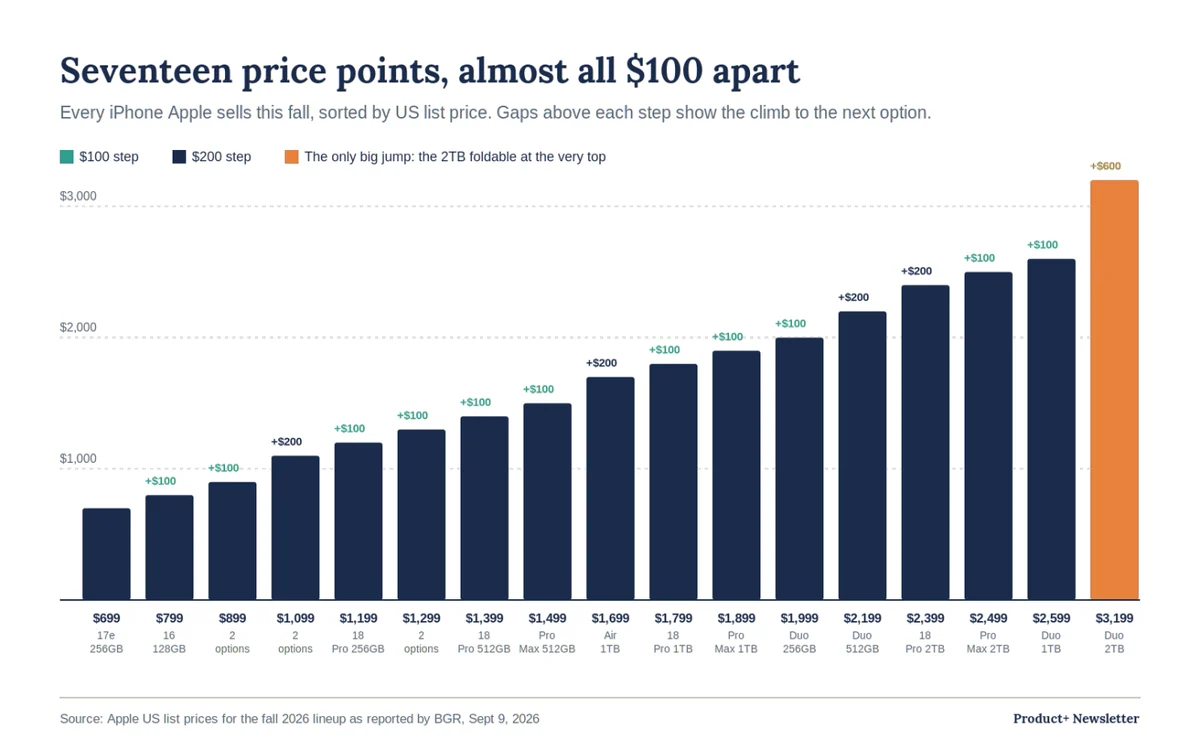
From $699 all the way to $2,599, there is never a gap larger than $200 between one option and the next. Most of the gaps are exactly $100. Seventeen distinct price points, and nearly every one of them sits a single small step above the last.
That is not an accident of engineering. The models differ in chips, cameras, materials, and screens, and the costs behind those differences are not arranged in tidy $100 increments. The prices are. Someone decided that no customer, standing anywhere on the ladder, should ever look up and see a cliff.
This is the core idea, and everything else Apple does builds on it. People rarely make one big decision to spend far more than they planned. They make several small decisions, each of which is easy to defend. A hundred more for the better camera. A hundred more for the bigger screen. Two hundred more so you never have to think about storage again. Each step is small relative to where you already stand, and the reference point keeps rising with you.
Jordan looked at her own pricing page again. $49, then $199, then a button that said Contact Sales. Her staircase had exactly two steps, and the first one was a wall.
Every rung connects to another ladder
The second thing Jordan noticed took longer to see, and it impressed her more.
Apple doesn't run just one staircase. Each model is its own ladder of storage options, and the ladders are set side by side so that the rungs line up across them.
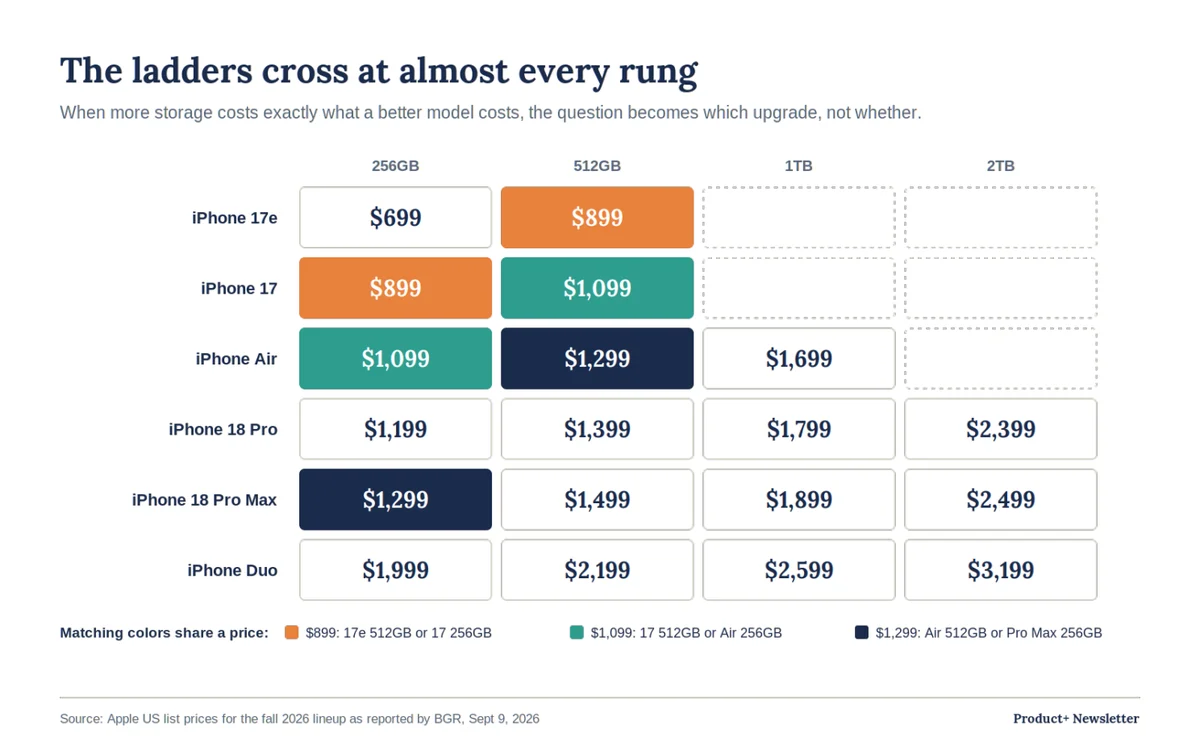
Look at where the prices land. A 512GB iPhone 17e costs $899, the same as a 256GB iPhone 17. A 512GB iPhone 17 costs $1,099, the same as a 256GB iPhone Air. A 512GB iPhone Air costs $1,299, the same as a 256GB iPhone 18 Pro Max.
So every time a customer considers more storage, they arrive at a price where a better phone is also waiting. Every time they consider a better phone, the storage question is sitting right beside it. The ladders cross at almost every rung, which means the customer is constantly choosing between two ways up, and almost never between going up and staying put.
That changes the question. "Should I spend more?" becomes "Which upgrade makes more sense?" and the second question is far easier for a buyer to answer with a yes. Jordan remembered this moment clearly. The specialist never asked whether she wanted the Pro. He asked whether she cared more about the camera or the storage, and when she said both, the 512GB Pro was simply the answer.
The base model is built to be almost enough
Apple's entry configurations are good products, and that matters. A weak base model feels like bait, and customers resent bait. But the entry options are also placed with care, just below where a lot of people will end up.
Storage is the clearest example. Photos, 4K video, offline music, and years of messages grow every year, and most people keep a phone for three or four years. A buyer choosing 256GB is not really choosing for today. They are placing a bet on how they will use the phone in 2029, and Apple knows most people will round that bet up.
Then look at how the storage steps are priced on the iPhone 18 Pro.
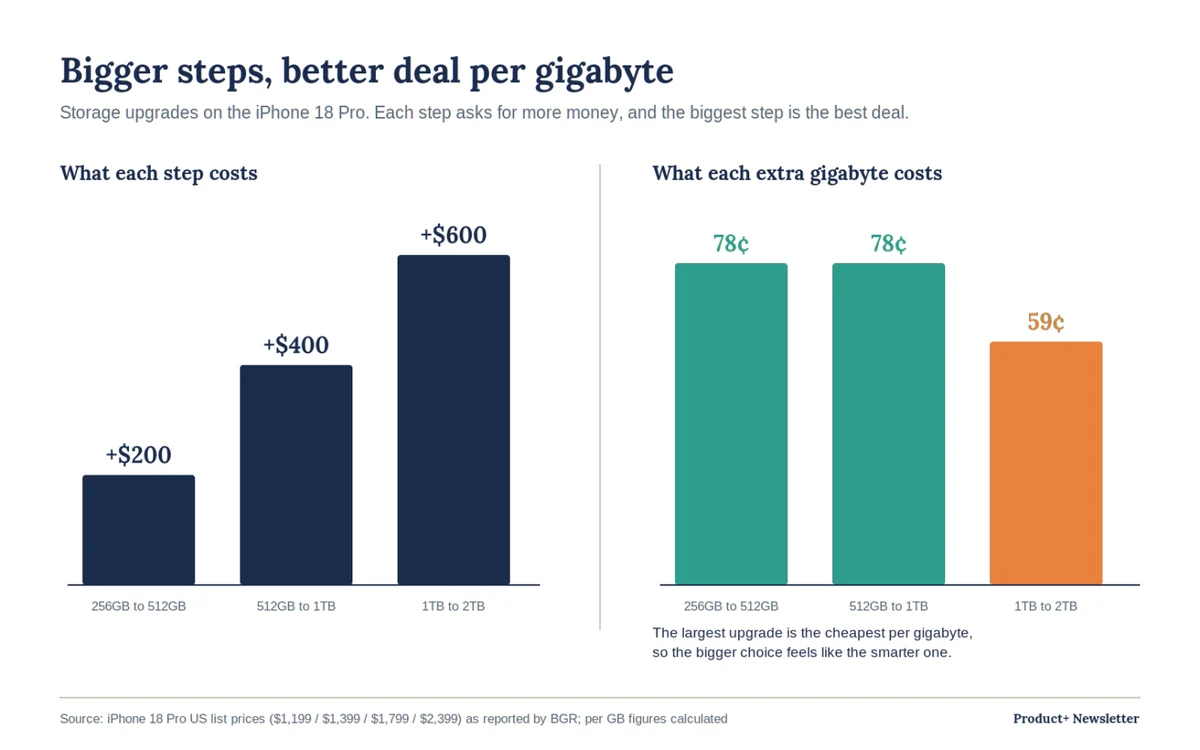
Moving from 256GB to 512GB costs $200. Moving from 512GB to 1TB costs $400. Moving from 1TB to 2TB costs $600. Each step asks for more money than the last, but the biggest step is also the best deal. The first two upgrades work out to about 78 cents for each added gigabyte. The jump to 2TB drops to about 59 cents.
So the larger choice feels like the smarter one, and in a narrow sense it is. The customer hesitating between two options is quietly told that the bigger one is the more efficient buy. It is the same logic a grocery store uses on the family size box, applied with remarkable discipline to a purchase that can top $2,000.
Jordan wrote a note to herself in the margin of her spreadsheet: our Starter plan isn't almost enough. It's either enough forever or not enough at all. Cadence's Starter plan capped clinics at three providers. A practice with two doctors never needed to upgrade, and a practice that hired a fourth hit a wall with nowhere reasonable to go. There was no gentle nudge, just a hard stop.
The anchor at the top changes how the middle feels
This fall Apple introduced the iPhone Duo, its first foldable, starting at $1,999 and reaching $3,199 with 2TB of storage. Relatively few people will buy one. That is not really the point.
Without the Duo, the most expensive iPhone on the page would be the 2TB iPhone 18 Pro Max at $2,499, and the $1,199 iPhone 18 Pro would sit at nearly half of that ceiling. With the Duo at the top, the same $1,199 Pro sits at about 37 percent of the most expensive option.
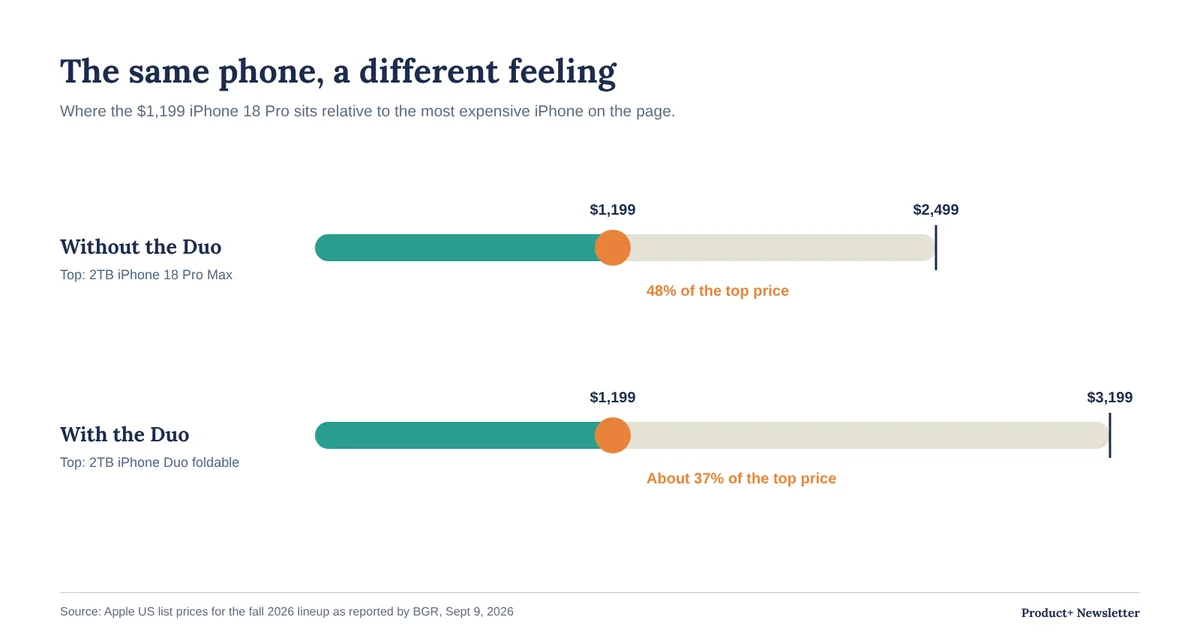
The Pro didn't get any cheaper. It just stopped looking like the expensive one.
Behavioral economists call this anchoring, and product teams talk about it constantly. What Apple does unusually well is make the anchor a real product that people genuinely want, review, and argue about, rather than a decoy that exists only to flatter the tier below it. The Duo earns its place on the page. Its effect on everything beneath it is a bonus Apple collects every time someone looks at a Pro and thinks, well, at least it isn't two thousand dollars.
It is worth noting that Apple raised prices across much of the lineup this year. Memory costs climbed across the industry, the Pro models started $100 higher than last year, and the iPhone 17 went up $100 instead of receiving its usual discount. What didn't change was the shape. The steps stayed small, the ladders still crossed, and the anchor moved higher. When a company can raise prices and still keep its customers moving up the staircase, the structure is doing real work.
The sale does not end at checkout
The part of the model Jordan found most instructive happened after she left the store.
Within a week her new phone suggested she back up her photos, and the free 5GB of iCloud storage was nowhere near enough. The iCloud+ plans follow the same staircase logic as the hardware: 50GB for $0.99 a month, 200GB for $2.99, 2TB for $9.99, then 6TB and 12TB for the truly committed. The first step is nearly free. The next step costs less than a coffee. And the storage she chose for the phone shaped which plan she needed to back it up.
Above iCloud sits Apple One, which bundles music, TV, games, and storage into tiers at $19.95, $25.95, and $37.95 a month. Once a household uses three or four Apple services, the bundle looks like savings, and the bundle is also why almost nobody cancels one service at a time.
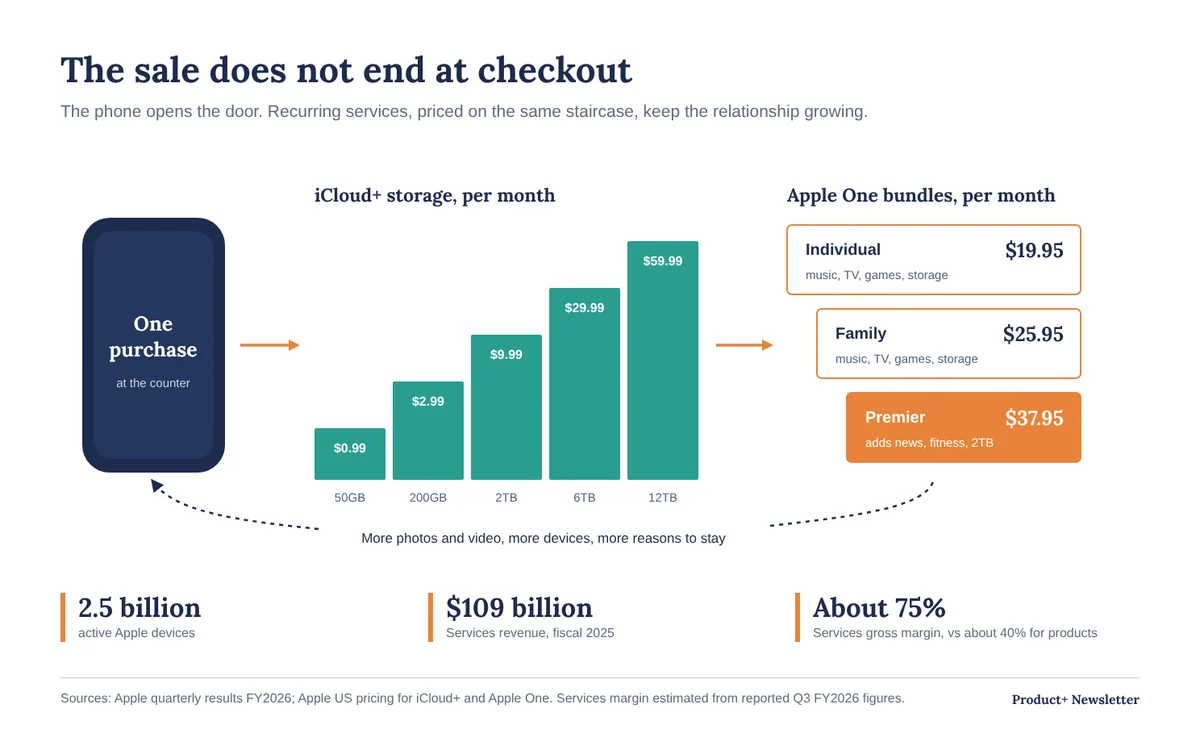
The scale is hard to overstate. Apple's installed base passed 2.5 billion active devices this year, and its Services business brought in about $109 billion in fiscal 2025. In the most recent quarter, Services revenue reached $30.7 billion. Working from the margins Apple reported that quarter, Services keeps roughly three quarters of every dollar as gross profit, compared with about 40 percent for products.
That changes how you should read everything above. The hardware staircase is not only about the size of the first sale. A customer who climbs to more storage, a better camera, and a bigger screen is also a customer who shoots more video, keeps more photos, and leans on more of the recurring services that follow. The upsell at the counter is the front door to a relationship that pays for years.
What Jordan changed
Jordan brought all of this to her team on Monday, and they spent the next three weeks rebuilding Cadence's pricing. Not by copying Apple, which sells phones to consumers, but by borrowing the structure underneath.
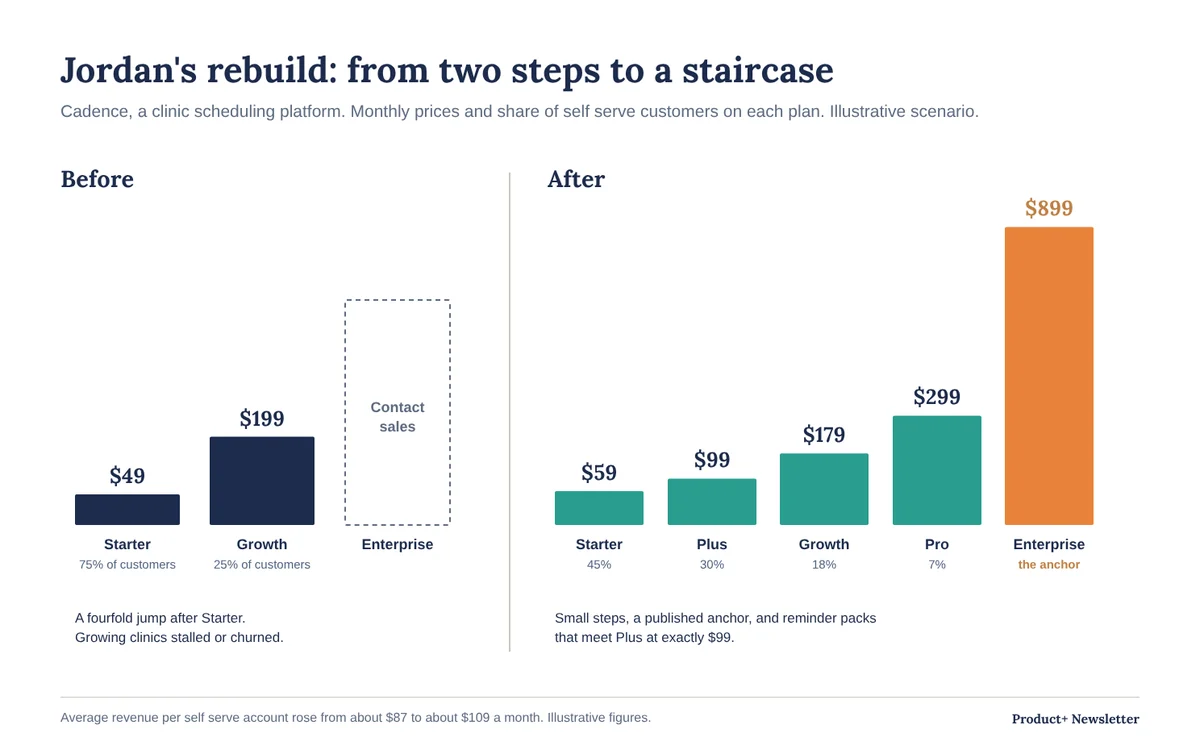
The first change was the staircase itself. Two plans with a fourfold jump became four plans with steady steps: Starter at $59, Plus at $99, Growth at $179, and Pro at $299. No clinic would ever face a jump that felt like a new budget conversation.
The second change was making the base plan almost enough. Starter kept everything a small practice needed, but the provider limit and the reminder allowance were tuned so a growing clinic would feel a gentle nudge a few months before it felt any real friction. The nudge pointed at Plus, which was only $40 away.
The third change was crossing the ladders. Jordan introduced reminder packs, bundles of extra text and email appointment reminders that any plan could add. A Starter customer buying two packs landed at $99, exactly the price of Plus, which included those reminders along with online booking and a waitlist. The question stopped being "do we pay more?" and became "which way up makes more sense for us?"
The fourth change was the anchor. Enterprise used to hide behind a Contact Sales button. Jordan published a starting price of $899 a month with everything included. Very few self serve customers would ever choose it, but Growth and Pro suddenly looked like the sensible middle of the page instead of its expensive end.
The last change was the recurring layer. Patient messaging, analytics, and integrations became optional extras with small staircases of their own, so the relationship kept growing after the first upgrade.
Two quarters later, the share of self serve customers on the cheapest plan had fallen from roughly three quarters to under half, and average revenue per self serve account had grown from about $87 to about $109 a month. What mattered more to Jordan was that churn among growing practices fell, because those clinics finally had somewhere to go when they outgrew Starter.
Borrowing the playbook
It would be easy to read Apple's pricing as a collection of clever tricks. That misses why it works. Every rung on Apple's staircase leads to something a real customer values: a better camera, a bigger screen, more room for the photos of their kids. The steps are small, but none of them are empty. Customers trust that climbing gets them something, and that trust is what makes the next step feel easy.
For product managers, the lessons travel well beyond phones.
- Design the whole staircase, not just the tiers. Look at your pricing page the way a customer does, standing on one plan and looking up. If any step feels like a cliff, customers will stay put or leave rather than climb.
- Build ladders that cross. Give customers two or three ways to spend a little more, and line them up so every path leads somewhere valuable. Choosing between upgrades is a far easier conversation than choosing whether to upgrade at all.
- Make the entry point almost enough. A good base plan earns trust. A base plan tuned to the real growth path of your customers sets up the next step before they know they need it.
- Put a real anchor at the top. Your highest tier shapes how every other tier feels, so make it a genuine offer with a visible price rather than a hidden quote.
- Plan for the relationship, not the transaction. The first sale is where the value begins, not where it ends.
Jordan still has the phone, and she still likes it. She says the extra storage was the right call. In the end, that is the whole lesson. The best upsell is the one your customer would defend on their own.
Apple doesn't sell you the expensive phone. It sells you the next step.
Sources
- Apple US list prices for the fall 2026 iPhone lineup, as reported by BGR on September 9, 2026 (opens in a new tab)
- Apple fiscal 2026 third quarter results (opens in a new tab) and first quarter results (opens in a new tab)
- Apple fiscal 2025 Services revenue, summarized from Apple's annual report by SQ Magazine (opens in a new tab)
- iCloud+ and Apple One US pricing, via Apple Support pricing pages
Jordan and Cadence are fictional, and the Cadence figures are illustrative.
Questions people ask
How does Apple price its iPhones to encourage upgrades?
With a staircase of small steps. The fall 2026 lineup has seventeen price points from $699 to $3,199, and up to $2,599 no gap is larger than $200, so every upgrade is a small, easy-to-defend step rather than a big jump.
What is price anchoring in Apple's lineup?
The $1,999 to $3,199 iPhone Duo foldable sits at the top of the page. Without it, the $1,199 iPhone 18 Pro is 48% of the most expensive option; with it, about 37%. The Pro didn't get cheaper; it just stopped looking like the expensive one.
How can SaaS companies apply Apple's pricing strategy?
Design the whole staircase so no step feels like a cliff, give customers crossing ladders (two ways to spend a little more), make the entry plan almost enough, publish a real anchor at the top, and plan for the recurring relationship after the first sale.
Putting this into practice
How Product Advisory helps teams with this: