Overcoming Common Pitfalls in Early Stage Product Development for Healthcare SaaS
Most healthcare startups don't fail on the idea. They fail on assumptions that don't hold up in real healthcare environments.
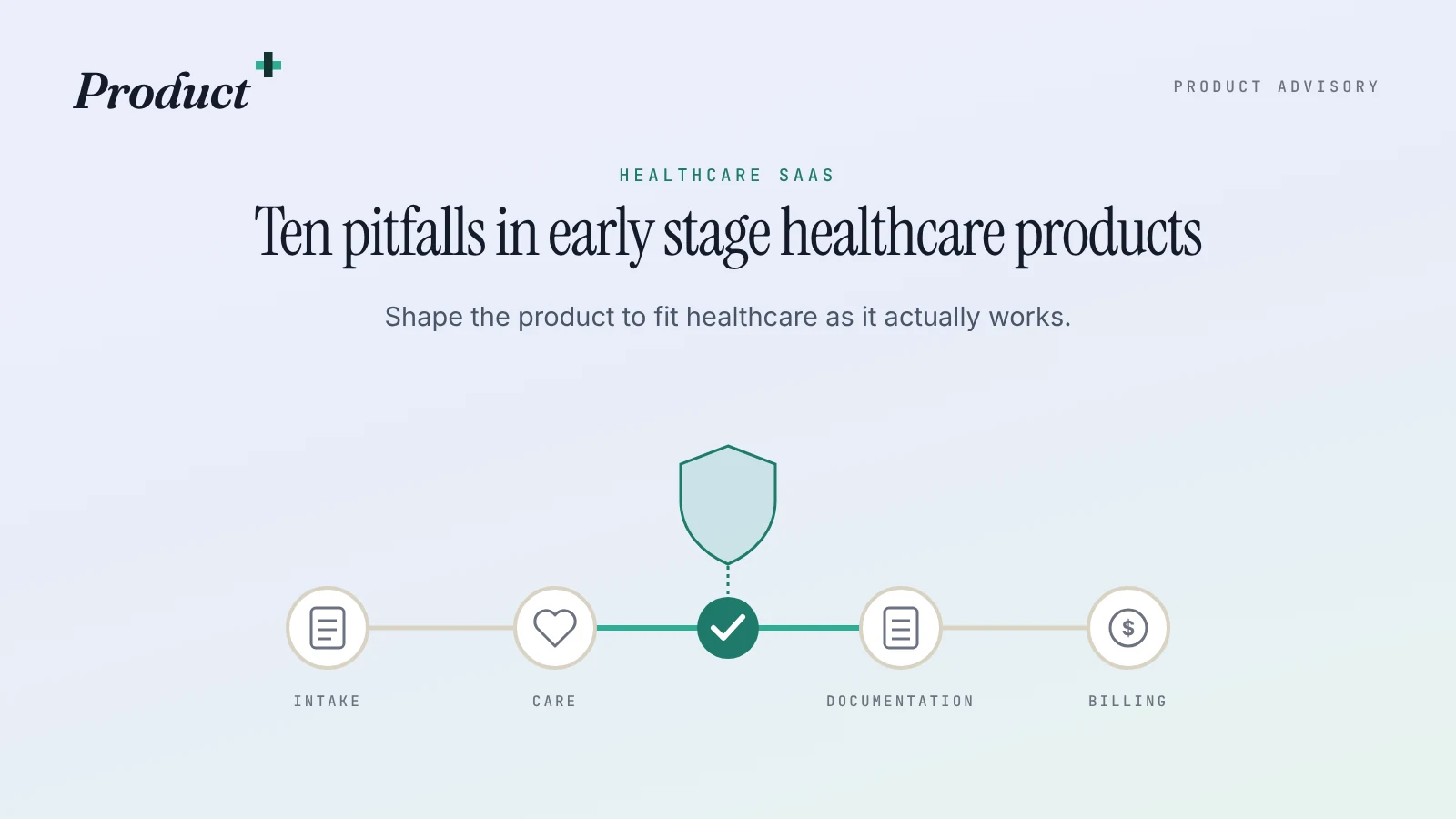
Building an early stage healthcare SaaS product can look deceptively similar to building software in any other industry. Founders often begin with a strong idea, a pressing problem, and a belief that good product execution will naturally lead to adoption. In healthcare, though, the path is rarely that straightforward. The industry is shaped by regulation, legacy systems, long buying cycles, sensitive data requirements, and a wide mix of stakeholders whose needs do not always align. That means many promising startups struggle not because the idea is weak, but because the product is developed with assumptions that do not hold up in real healthcare environments.
The good news is that many of the most common mistakes are avoidable. Early teams that understand where healthcare SaaS development tends to go wrong can make smarter decisions from the start. They can build products that are easier to adopt, easier to trust, and far more likely to survive the jump from concept to scalable business. Here are ten pitfalls I see most often, and how to avoid each one.
1. Building around the founder's vision instead of the user's workflow
One of the biggest mistakes early stage healthcare SaaS startups make is building around the founder's vision instead of the user's workflow. A problem may seem obvious from the outside, but healthcare professionals operate in highly structured environments with established processes, compliance demands, and severe time constraints. A product that appears valuable in theory may create friction in practice if it asks clinicians, administrators, or billing staff to change too much too quickly. Startups often mistake interest during interviews for true product fit, only to discover later that the solution does not integrate naturally into the daily rhythm of care delivery or operations.
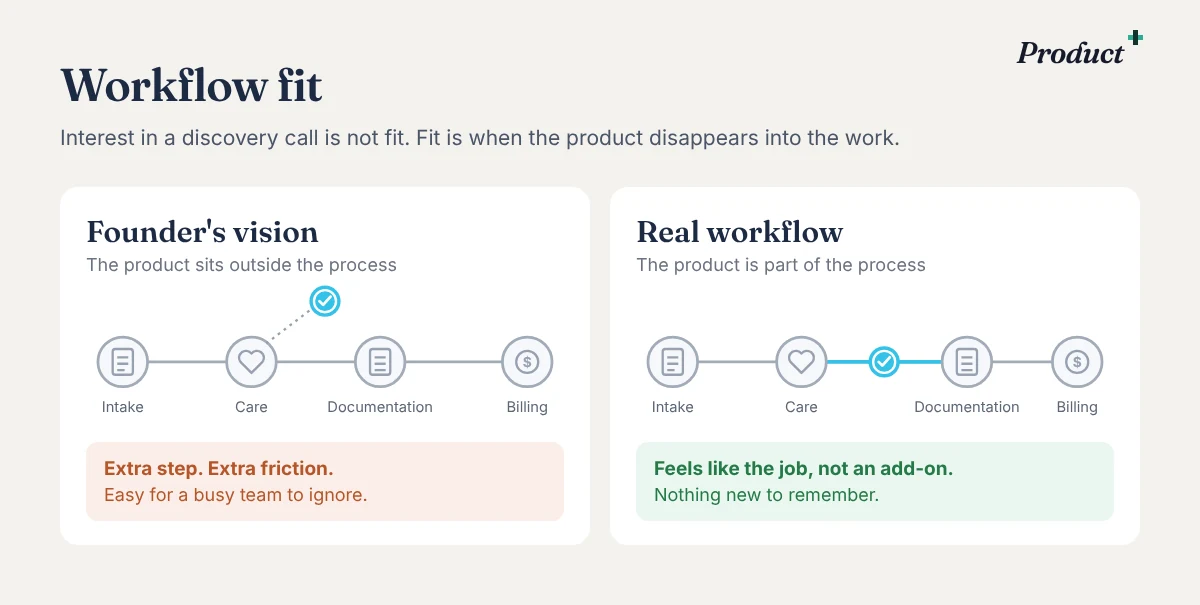
Avoiding this pitfall requires more than a few customer discovery calls. Teams need direct exposure to real workflows, real constraints, and real decision making inside healthcare organizations. That means talking to end users, economic buyers, technical stakeholders, and compliance leaders rather than relying on one champion to represent everyone. The goal is not just to validate the problem, but to understand how work actually gets done and where a new tool can fit without creating disruption.
2. Trying to build too much too early
Healthcare startups often feel pressure to appear enterprise ready from day one, which leads them to create bloated products packed with features for multiple use cases. In many cases, this comes from hearing a wide range of requests from prospective customers and attempting to satisfy all of them at once. The result is usually a product that is complicated, expensive to maintain, and unclear in its core value proposition.
In early stage product development, focus is a strategic advantage. The strongest healthcare SaaS products usually begin by solving one painful problem for one clearly defined user group. They establish credibility through depth before expanding through breadth. A narrow initial scope can also make implementation easier, reduce risk for customers, and provide cleaner signals about what the market actually values. Instead of asking how to build a platform immediately, founders should ask what single problem they can solve exceptionally well.
3. Underestimating integration
In healthcare, standalone software often struggles to gain traction. Providers, payers, and health systems already rely on electronic health records, billing tools, scheduling systems, patient engagement platforms, and internal reporting systems. If a new product cannot connect to this environment, the burden shifts to the customer, and that burden can quickly become a deal breaker. Startups sometimes postpone integration planning because they view it as a later stage technical challenge, but in healthcare it often affects product viability from the beginning.
To avoid this, treat integration as part of the product strategy rather than an afterthought. Identify which systems matter most to your target customers and understand the real effort required to connect with them. Be honest about whether your minimum viable product can deliver value without deep integration, or whether interoperability is central to adoption. In many cases, a simpler integration strategy focused on one or two high-value connections is more realistic than promising broad compatibility too soon.
4. Leaving security and compliance for later
Some early teams assume they can address HIPAA, data governance, auditability, and security controls later, once traction appears. That approach is risky. In healthcare, trust is not a finishing layer added after the product works. It is part of the product itself. Buyers want to know how patient data is stored, who can access it, how permissions are managed, and whether the company has taken security seriously from the start. A product that lacks these foundations may lose deals long before the conversation reaches pricing or implementation.
This does not mean early stage companies need to overengineer every policy and certification before speaking to customers. It does mean they should build with compliance-aware habits from day one: access controls, logging, secure infrastructure, clear data handling practices, and informed legal guidance. These steps help startups avoid expensive rework and signal maturity to customers who are evaluating risk as much as functionality.
5. Confusing user enthusiasm with buying intent
In healthcare organizations, the person who loves a product is often not the one who approves the budget, signs the contract, or clears procurement. A clinician may strongly support a tool that improves workflow, but the final decision could depend on department leadership, finance, IT, legal, or compliance. Startups that build based only on user enthusiasm may end up with a product people want but organizations still will not buy.
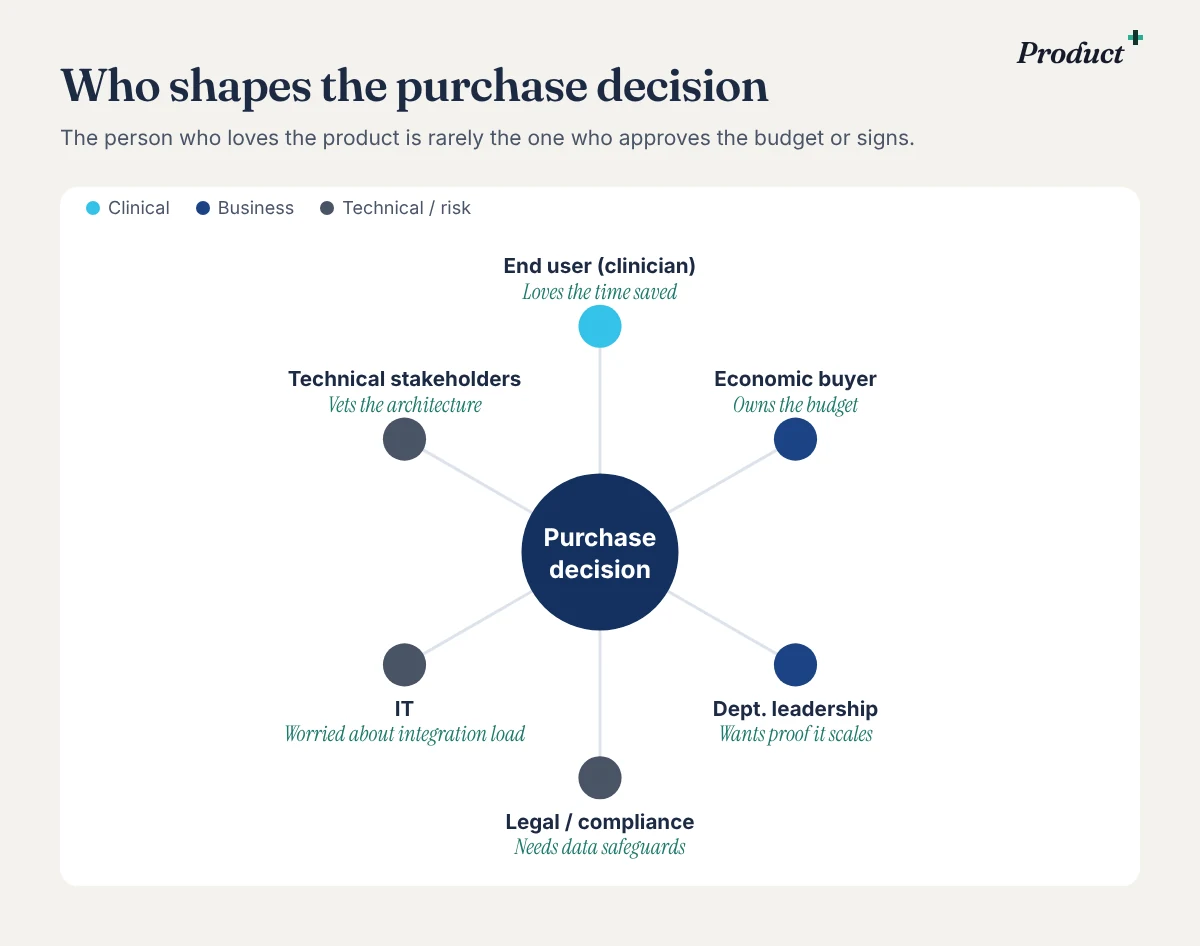
Successful teams map the full buying journey early. They learn who benefits from the product, who influences the decision, who owns the budget, and what objections each stakeholder is likely to raise. This shapes not only the product but also implementation plans, ROI messaging, security documentation, and sales strategy. In healthcare SaaS, product development and go-to-market development are tightly linked. Ignoring that connection often leads to painful delays later.
6. Not proving measurable value quickly enough
Because budgets are tight and adoption can be slow, buyers need a strong reason to prioritize a new solution. If the product's impact is vague or difficult to measure, it is much harder to justify implementation. Founders sometimes lean on broad promises such as improving care quality, increasing efficiency, or enhancing patient engagement, but those claims need to translate into outcomes that customers can track and defend internally.
Define success metrics early and build the product in a way that supports them. Depending on the use case, that could mean reduced administrative time, faster patient throughput, lower no-show rates, improved documentation accuracy, higher collections, or better patient retention. The key is to connect product usage to business or clinical outcomes that matter to the buyer. A product that delivers visible, measurable value has a much better chance of surviving pilots and expanding within an organization.
7. Running pilots that never reach a decision
Many healthcare SaaS startups treat pilots as loosely defined trial periods rather than structured validation opportunities. Without clear success criteria, ownership, timelines, and implementation support, pilots often drag on without producing a real decision. Teams may assume that continued engagement means progress, when in reality the customer has simply not prioritized the evaluation.
Design pilots with discipline instead:
- Agree up front on goals, user groups, duration, metrics, and decision points.
- Keep setup light so the customer experiences value quickly.
- Make the pilot answer one specific question: does the product work in this environment, and does it merit broader adoption?
If that question is never clearly defined, the pilot can consume time and resources without moving the business forward.
8. Building without enough clinical or domain expertise
Even highly talented software teams can miss critical nuances in healthcare if they lack firsthand understanding of regulations, workflows, reimbursement models, and operational realities. This can result in products that feel polished on the surface but fail in the details that matter most to users. In healthcare, those details are rarely minor. A misunderstanding around documentation requirements, data visibility, or decision support can create serious adoption barriers.
Reduce this risk by involving domain expertise early and continuously: clinical advisors, operators from provider organizations, reimbursement experts, compliance consultants, or experienced healthcare product leaders. The goal is not to slow innovation but to ground it in reality. The earlier a team can identify faulty assumptions, the cheaper and easier they are to correct.
9. Ignoring implementation as part of product design
A product may be elegant in demos and still fail in deployment if onboarding is too manual, configuration is too complex, or training requirements are too high. Healthcare organizations rarely have unlimited capacity to absorb new tools. If implementation feels heavy, even strong products can stall.
That is why implementation is a core product concern. Ask how quickly a customer can get live, how much internal effort is required, what data needs to be migrated, what training is necessary, and where users are likely to get stuck. Reducing time to value is especially important in early stage healthcare SaaS, because it strengthens customer confidence and shortens the gap between interest and proof.
10. Chasing credibility signals instead of readiness
Many startups focus heavily on looking established through polished branding, broad feature sets, and large vision statements, while neglecting the hard work of validating demand, tightening workflows, and delivering repeatable results. In healthcare, credibility does matter, but it is earned through trust, consistency, and evidence rather than presentation alone.
The most resilient healthcare SaaS companies tend to grow from a strong operational foundation. They understand a specific user deeply, solve a painful problem clearly, build trust into the product, and create a path to measurable value. They do not assume healthcare will adapt to the product. They shape the product to fit healthcare as it actually works.
Complexity can become a moat
Early stage product development in healthcare SaaS is challenging because the stakes are high and the environment is complex. But complexity does not have to be a disadvantage. For startups willing to listen closely, focus narrowly, and build with discipline, it can become a moat. Avoiding common pitfalls is not just about preventing failure. It is about creating the conditions for real adoption, durable trust, and long-term success in one of the most demanding markets in software.
Questions people ask
Why do early stage healthcare SaaS products struggle?
Usually not because the idea is weak, but because the product is built on assumptions that don't hold up in real healthcare environments: regulation, legacy systems, long buying cycles, sensitive data and many stakeholders whose needs don't always align.
How narrow should a healthcare SaaS MVP be?
Narrow enough to solve one painful problem exceptionally well for one clearly defined user group. That builds credibility through depth, makes implementation easier, lowers risk for customers and gives cleaner signals about what the market values.
When should a healthcare startup plan integrations?
From the start. Identify which systems matter most to your target customers, be honest about whether your MVP can deliver value without deep integration, and focus on one or two high-value connections rather than promising broad compatibility.
Who buys healthcare software?
Rarely just the person who loves it. Clinicians, department leaders, finance, IT, legal and compliance can all shape the decision. Map who benefits, who influences, who owns the budget and what each will object to.
What makes a healthcare SaaS pilot succeed?
Agreeing up front on goals, user groups, duration, metrics and decision points, and keeping setup light so the customer reaches value quickly. A good pilot answers one specific question: does this work here, and does it merit broader adoption?
Putting this into practice
How Product Advisory helps teams with this: